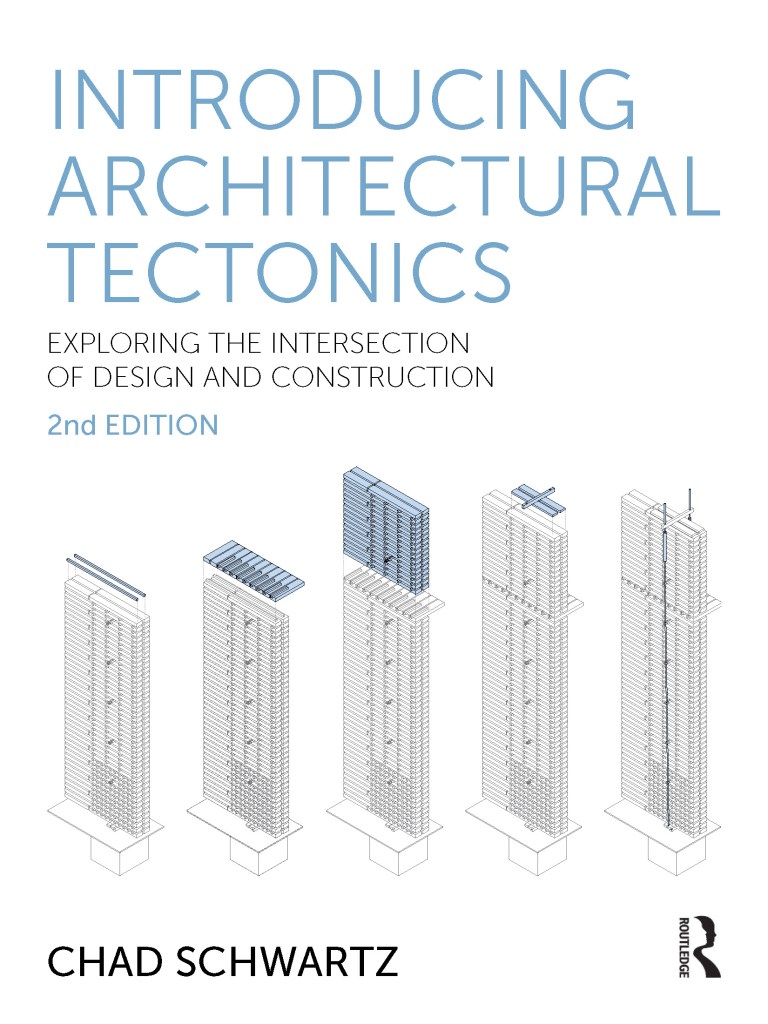
The second edition of Introducing Architectural Tectonics: Exploring the Intersection of Design and Construction is an exploration of the poetics of construction. Tectonic theory is an integrative philosophy examining the relationships formed between design, construction, and space while creating or experiencing a work of architecture. In this text, I present an introductory investigation into tectonic theory, subdividing it into distinct concepts in order to make it accessible to everyone.
The book centers on the tectonic analysis of twenty contemporary works of architecture, located in over a dozen countries across the globe and designed by notable architects such as Tadao Ando, Herzog & de Meuron, Kengo Kuma, Peter Zumthor, Xu Tiantian, and Francis Kéré. Although similarities do exist between the projects, their distinctly different characteristics and range of interpretations of tectonic expression provide the most significant lessons to help you learn about tectonic theory.
This second edition has been updated to include the tectonic analysis of four new architectural precedents:
From Nigeria, the Makoko Floating School by NLÉ
From Burkina Faso, Lycée Schorge by Kéré Architecture
From Mexico, the Matamoros Public Market by Colectivo C733
From China, Quarry #8 by DnA_Design and Architecture
Written in clear, accessible language, these investigations examine the poetic potential of architecture, presenting lessons and concepts that you can integrate into your own work, whether studying in a university classroom or practicing in a professional office. Below, you will find the Preface from the book which explains my intent behind its creation. Please visit my ResearchGate page to download a copy of the book’s introduction.
First Edition Introduction | ResearchGate
For more information or to purchase the book, please click on one of the following links:
Second Edition | Routledge
Second Edition | Amazon
Routledge Featured Author Page
Preface | Building a Foundation
To the Second Edition
In the initial discussion about creating this second edition, the team at Routledge asked me what changes I would like to make to the book. With their guidance, and with feedback from several outside parties, the answer soon became obvious. In 2014, when I first started working on this project, most of the twenty case studies I included were projects I often referenced for my students in class. The rest I stumbled upon over the years, earmarking them for analysis because they sparked my tectonic interests. My greatest concern in assembling the set of twenty involved creating a collection that spanned a broad range of construction types.
Looking back, while I also attempted to collate a global selection of works, the inclusion of eight projects in the United States – seven by US-based firms and one by a European firm – diminished the overall diversity of the collection. Remedying that situation was the priority in the development of the second edition. Four new project chapters have replaced four of the original chapters focused on American architecture. It was not possible to simply make the book longer, so cuts – very painful cuts – were necessary. The limited number of projects to choose from,[i] however, quickly brought the framework of the new edition into focus. The analyses of Olson Kundig’s Brain Studio, Predock_Frane’s Center of Gravity Foundation Hall, Lake|Flato’s Government Canyon Visitor Center, and Richard Kennedy’s Arabian Library may no longer be part of the printed book, but it is certainly not because of their lack of architectural pedigree or tectonic quality. As such, here are edited versions of these chapters for your reference.
Arabian Library | Richard Kennedy Architects
Center of Gravity Foundation Hall | Predock Frane
Government Canyon Visitor Center | Lake|Flato
In their place, four new chapters analyze projects located in Nigeria, Burkina Faso, Mexico, and China. I hope the increased diversity of locations, economics, contexts, and firms will broaden the book’s reach for the global architectural community. In addition to these changes, I have updated the text and drawings throughout. Almost a decade after writing the first edition, not only has my writing style changed, but my approach to diagramming has as well. I hope you find this revised edition to be an even more streamlined, legible, and valuable study of the theory of architectural tectonics.
From the First Edition
In the opening lines of The Tell-the-Tale Detail, the late architect and educator Marco Frascari wrote:
Elusive in a traditional dimensional definition, the architectural detail can be defined as the union of construction, the result of the logos of techné, with construing, the result of the techné of logos.[ii]
In the Greek language, logos means discourse or the communication of thought through conversation while techné refers to the practice of making an object using previously gained knowledge.[iii] Frascari’s logos of techné, therefore, can be translated as a conversation about making and constructing. Its counterpart, the techné of logos, reads as the making of conversation or a discussion leading to the understanding of meaning. This quotation – as well as the rest of Frascari’s essay – serves as a catalyst for the study of the architectural detail, of the making of things, and of the theoretical premise of the tectonic. Frascari asserted that the joining of elements is not simply an act of construction, but a process that helps to define the space created through construction.
Learning about this perspective on architecture through the knowledge and analysis compiled in this book, offers opportunities for enthusiastic students of architecture to:
1: Engage with the meaningful dialogue that exists between design, construction, and theory in the study of the built environment.
2: Avoid the roadblocks often found in works of architectural theory – verbose language, discipline-specific terminology, and a surplus of unknown references – in the pursuit of an advanced line of architectural thought.
3: Gain exposure to a process of analyzing and learning from architectural precedent. These studies need to be carefully calibrated to avoid superficial engagement and focus on the excavation of critical lessons that teach the HOWs and WHYs of a given project.
This book endeavors to deliver to you an understanding of the integrative potential of architectural tectonics. Just as Frascari did in The Tell-the-Tale Detail, this text presents a conversation about the making of architecture that will hopefully resonate with you as you begin – or continue – your investigation of the built environment.
[i] A handful of US-based projects could not be removed for various reasons. For example, Thorncrown Chapel was a foundational study that inspired the book and anchored the proposal I originally submitted to Routledge and the Loblolly Residence’s prefabrication was unique in the original publication.
[ii] Marco Frascari, “The Tell-the-Tale Detail,” VIA 7: The Building of Architecture (1984): 24..
[iii] Adrian Snodgrass, “On ‘Theorising Architectural Education’,” Architectural Theory Review 5, no. 2 (2000): 89.
 Chad Schwartz Research Anthology